
.jpg)
Tropical Storm Melissa
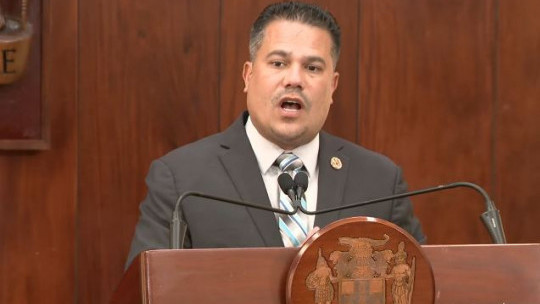
Environment and Climate Change Minister Matthew Samuda
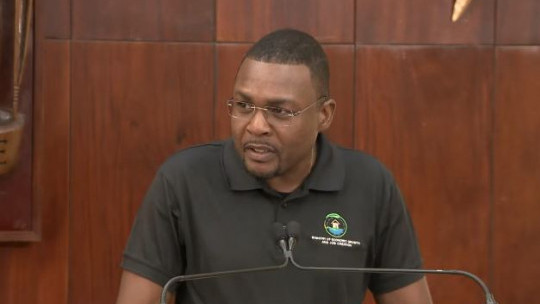
Robert Morgan, Minister with responsibility for Works
.png)
Evan Thompson, Principal Director of the Met Service of Jamaica; Environment and Climate Change Minister Matthew Samuda; Local Government Minister Desmond McKenzie; and Robert Morgan, Minister with Responsibility for Works
Tropical Storm Melissa is inching closer to Jamaica and is expected to impact the island as early as Thursday.
The system has slowed its forward speed, and forecasters predict that it could make landfall in Jamaica based on its trajectory.
Jamaica still remains under Tropical Storm Watch, which means tropical storm conditions are possible within 48 hours.
Principal Director of the Meteorological Service of Jamaica Evan Thompson says Melissa is likely to become a hurricane, and in its passing over the weekend, it's expected to further strengthen.
"There is still some possibility of the system actually making a landfall in Jamaica. Right now, it will move closer to the island then turn towards the west and staying south of the country. That is where the general forecast is. So as the system continues to move closer to us, we do expect that gradually we will start to see the increase in rainfall occurring on Thursday. Late on Thursday, there is the possibility of sections of the country starting to be impacted by some tropical storm conditions. So while it is moving toward the west over the water south of the island, there is a good chance that this system will develop into a hurricane," he explained at a special press briefing from the Office of the Prime Minister on Wednesday morning.
He said the weather system is expected to affect all parishes, but mostly those in the eastern and southern sections of the island.
"As the system becomes a hurricane, which is likely to take place on the weekend, it will continue to move and there is now the possibility that it will also become a major hurricane while it is over the water south of us. The rainfall, however, is likely to cover most of the island. Eastern parishes are most saturated and also southern sections of the country. On the chart that you see now, it shows that the eastern end of the island could have up to anywhere between 8 and 12 inches of rainfall. Now, that is significant rainfall," he said, pointing to a graphic shown at the press briefing.
Meanwhile, Environment and Climate Change Minister Matthew Samuda said all systems are a go as emergency services move into response mode.
The minister urged calm and said the government is coordinating very closely with all stakeholders.
"This will require an all of government response, but we want to assure citizens that they will get timely updates from the Met Service. We are now using our own Doppler radar and we are very clear that we have had to mobilise our other agencies to ensure that they provide particular support through their early warning systems. So, NEPA is on guard, we have through the National Water Commission, engaged all of our emergency protocols. We are already monitoring our situations related to our hospitals and our infirmaries to make sure that they are served right through any storm if it does indeed hit us, and certainly in the immediate aftermath," he advised.
Deputy Chairman of the National Disaster Risk Council and Minister of Local Government and Community Development Desmond McKenzie said over 800 shelters have been inspected in preparation for the hurricane season and are on standby, while relief supplies have been pre-positioned in various sections of the island.
However, he said there are serious concerns regarding certain flood-prone communities.
"There are some particular communities in Jamaica that we are concerned about. Rocky Point in Clarendon is one. Taylor Land in the eastern part of the island is another. We have the Duhaney Park area, New Haven, and several other communities. The Burger Gully, the McGregor Gully are two areas of concerns. Presently, we are undertaking operations in that section of East Kingston by installing over a thousand sandbags," he disclosed.
Additionally, he urged residents of Port Royal, especially, to comply with any possible evacuation orders.
The government has been conducting assessments of vulnerable areas across the island, with Minister with responsibility for Works, Robert Morgan, saying Kingston and St. Andrew is of particular concern to the authorities.
"Persons who live on gully banks continue to be vulnerable whenever we have a potential rain event and it is something that the government has been looking at and we are taking very seriously, as not only is there a risk to property, but it is also a significant risk to life and also a risk to persons who may seek to assist these persons if a disaster takes place," he warned.
Mr. Morgan, who was also addressing the special press briefing, reiterated that the government is in the early stages of planning a solution for people residing on gully banks, adding that an announcement will come from Prime Minister Dr. Andrew Holness.
The Shoemaker Gully and the Sandy Gully are also getting attention.
"The challenge of the Sandy Gully is very peculiar. Sandy Gully is the main drain of Kingston, and over the years a lot of silt has developed. The Prime Minister did announce in March, in his budget presentation, [that] a significant effort to be made to do repair work and cleaning of the Gully to the tune of several billion dollars. That is a capital expenditure that requires a particular process, which does take some time, but in the interim, the government continues to monitor the Sandy Gully and several sections along the Gully and also its tributaries to see where the vulnerabilities exist to ensure that in case of an event we can act quickly or we can do whatever we can in the beginning to prevent disaster," said Mr. Morgan.
He added that contractors have been engaged to stockpile critical materials that will be essential after the passage of the storm.
Minister Morgan said drains in major towns have been cleaned in preparation for an active hurricane season. He said funding has also been provided to local authorities for the cleaning of drains.
But he admitted that drains across the island are not fit for purpose in light of the challenges associated with climate change and the built environment.
"We have done some work through various capital projects and various design changes in how we build infrastructure that is over time ameliorating these challenges. However, it will take some time for the country to upgrade its drainage network," he acknowledged.
comments powered by Disqus
.jpg)
.jpg)





 All feeds


