
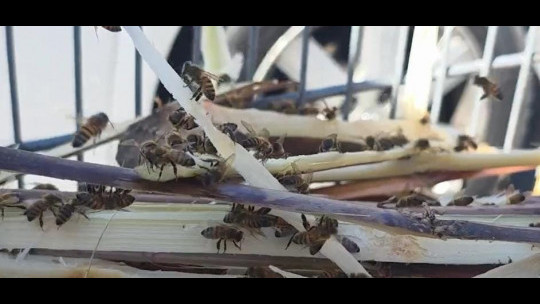
.png)
Hugh Smith, Chief Plant Protection Officer at the Apiculture Unit in the Ministry of Agriculture and bee farmer Mark Webster
The Ministry of Agriculture is estimating that bee farmers have lost millions of dollars due to the hurricane.
This is based on discussion with some 100 farmers in western Jamaica.
But Chief Plant Protection Officer at the Ministry's Apiculture Unit, Hugh Smith, says connectivity issues continue to hamper the damage assessment.
"We have only been able to receive reports from some 3% of the bee keepers, and that 3% represents $75 million worth of loss. This is just from 106 bee keepers. During the course of today, we got another 60-70 reports. Remember, these reports are interrupted by communication. So the heart of St. Elizabeth, you're not getting. The heart of Westmoreland, you're not getting that; Hanover, we are just not getting all the details because you can't reach the people and the communication with the telephone is seriously slow at this time," lamented Mr. Smith, who was speaking Tuesday on Radio Jamaica's Beyond the Headlines.
Meanwhile, bee farmers say Hurricane Melissa has devastated their apiaries in St. Elizabeth and Westmoreland.
Mark Webster described it as total destruction.
"I lost probably over 80% and the counting of my bees. The reason why I am counting, some of the bees, we were not able to do the proper assessment to see if they are queens which will make them viable. And so that is still counting. So far, my losses are over 100 boxes of bees. This is a great impact on my bees business. I had started this business and grown it to the extent where I say it could be my pension. But the impact now, if it is that I am not able to bounce back, it will have a very, very negative impact on my business."
Mr. Webster said he does not believe the bees in St. Elizabeth can be replenished.
"The trees, the flora there is totally decimated. The trees are scorched brown. The juice have been licked out of them. And so I see that the best way to approach this is to have other farmers from other parishes who have their bees, to get in support, whether it is from local or international, to get support to expand their businesses and to supply St. Elizabeth with bees when the flora, when the trees start to replenish, start to grow back. But for right now, there will be no food for the bees in St. Elizabeth," he reasoned.
comments powered by Disqus






 All feeds


