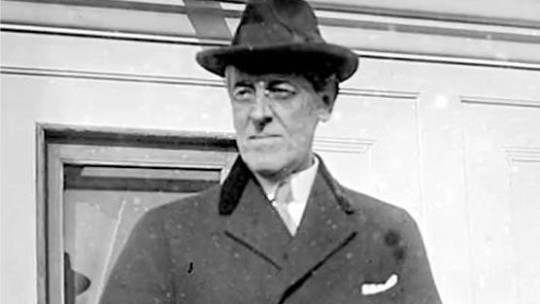
Woodrow Wilson led in the creation of short-lived League of Nations

7:13 pm, Tue January 20, 2026
Woodrow Wilson led in the creation of short-lived League of Nations
By Bumpy Walker
The year 1919 was an historical inflection point. Most importantly, it was the year my father was born; the world was ravaged by “Spanish Flu” and Woodrow Wilson, the then President of the United States, visited Paris to attend the post World War One peace conference. The intention of the POTUS was to negotiate a peace to prevent a repeat of the just concluded world war. Two institutions he wished to build were the creation of nation states based on the nebulous and ill defined concept of nationality. The other was the creation of a transnational collective, the “League of Nations”
The League of Nations was meant to prevent nations from fighting wars by the settling of disputes. Its tool was meant to be economic war: trade boycotts used to impose “collective security”, stymie hegemonic nations seeking to impose their wills on neighbours and near neighbours. This was an era when Europeans saw themselves as the only competent rulers.
The League of Nations failed. In the 1930s the Japanese invaded China. Other nations ignored the League's directives. The death knell of this collective followed in 1939 when the Italians invaded Abyssinia and deposed the god king Sellasie I, without receiving sanctions. Powerful nations preferred trade with hegemons than to protect militarily weaker nations.
Suez and all that
Before the end of a second world war, a conflict partially rooted in the 1919 Peace in Paris, the The allies identified part of the failure of post 1919 peace as the lack of international rules based economics. An economic order was developed at the Bretton Wood Conference in 1943 that has remained in place though constantly evolving. Among the main planks of this new order were a dominant dollar, linked to the value of gold, and the establishment of the World Bank and the IMF.
Post World War II, In 1956 Israel, France and Great Britain invaded Egypt, their claus belli being a false narrative that Egyptian troops had invaded Israel. This action is now accepted as being due to the French and British wishing to reclaim the nationalised Suez Canal Company.
For the Isrealis, this military action was to capture more territory which included a number of small producing oil fields.
Based on a more recent assessment, a contributing factor was that at a state dinner, the much younger wife of the British PM Antony Eden, fell under the charismatic spell of the President of Egypt Abdel Nasser. Eden, it seems, let his ego (and belief in European exceptionalism) went to war to improve his sex appeal and humiliate his perceived rival.
This military action led to a run on the Great British Pound. The US refused to lend the UK dollars to tide them over this short term economic embarrassment unless the Suez Crisis was deescalated A future British Chancellor of the Exchequer (finance minister) is reputed to have said in the 1980s that this was the only successful use of sanctions.
In the 1970s the link between the US dollar and gold was unilaterally broken by the Nixon administration. The US dollar remained the principal currency for world trade, given it was the most widely traded currency.
Post Soviet Union
A period of globalisation began prio rto the fall of the Soviet Union, in combination with the advance inconnectivity between commercial and central bank interdependence. This system of financial inter-contectivity developed institutions to smooth and reduce the inertia of international trade. These institutions ultimately handed unprecedented power to the US Government: it had amazing oversight as well as ultimate control of the principal instrument of trade; the US dollar.
During the eight years of the Obama Presidency, US policy reverted to the Wilsonian principle of economic war; to bring rivals to the negotiating table using this government control of dollar domiminated trade systems. The principle was to target the rival's banking system, along with using secondary sanctions on large multinational banks and international corporations effectively stopping trade. Billion dollar fines were placed on such luminaries as HSBC, BNP Paribas for providing work- arounds for the Iranians to bypass the sanctions imposed to end their nuclear programme. There was also the additional threat of being excluded from the banking system. This was the greatest success of multinationalism in the spirit of Wilsonian diplomacy. These sanctions were so successful that banks refused to re-engage with the Iranians even when told by the US Secretary of State that it was acceptable.
On other occasions the cautious Obama regime repeatedly used the Wilsonian concept of economic weapons and diplomatic engagement on international rivals, the two prime examples being North Korea, forcing it to negotiate on nuclear development, and more spectacularly on Russia, causing it to pull back from using military force to take over a third of Ukraine in 2014, though this attempt did resume.
To counter this threat, the Chinese and Russian government developed work-arounds to bypass the US dollar-dominated system. Also in parallel was the development of the “un-understandable” cryptocurrency. This reduced the US dollar’s domination, lowering the effectiveness of this economic weapon. This has been manifested in the re-invasion of Ukraine by Russia and the increasing military posture of China towards Taiwan.
Unilaterialism and Hegemony 2.0
When the Trump regime literally tore up the rules-based book, the idea of multilateral action and subtle diplomacy was replaced to a pre Napoleonic war attitude. Small nations are at the mercy of the local hegemon. The triumph of the Obama era, the US led, rival endorsed Joint Comprehensive Plan of Action (JCPOA) Treaty was torn up. Naked threats and military action are once more the international order.
Venezuela, our Caribbean neighbour, has once more experienced the 19th century political milieu. Being a dictatorship with territorial claims on multiple CARICOM members, its powerless rhetoric tweaked the nose of its powerful near neighbour. The result was a multi decade economic war via sanctions and secondary sanctions.. Despite this, it was still standing barefoot, with its economy battered and bruised. This demonstrates that there are now available options to the US dominated world economic / trading system, developed organically from the Chinese, Russians, North Koreans and Iranian sanction busting experience. Once more war by economic means has lost its sting, although it can still gravely wound an economy.
The result was a putative military expedition that deposed the Venezuelan head of state. Unlike his fellow dictator Haile Sellasie who escaped to exile in the 1930s, he was arrested and will face criminal charges at the hands of the local hegemon. The outcome of this action is too soon to predict. The analog is akin to the princely states, during the Indian colonial Raj: Local British administrators chose the local rulers demanding, not loyalty, merely abasement.
As with the Suez crisis, this Venezuelan vendetta seems to be ego driven, in part. What is clear is that the world has once again moved back to a time when the military trumps economic war as a means of imposition of a strong nation’s will.
Bumpy Walker is mystified, stumped by the complexity of world economics, does not get crypto currency, but owns some!

By Gordon Robinson So

By Bumpy Walker A lon

By Bumpy Walker In th

By Bumpy Walker In 20

.jpg)



 All feeds