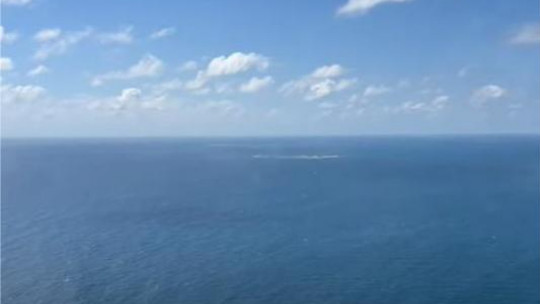
A section of Jamaica s Pedro Bank

6:57 pm, Sat October 11, 2025
A section of Jamaica s Pedro Bank
By Bumpy Walker
In 2003 literally all the major oil companies made bids in a public auction to the tune of half a billion US dollars for the right to drill for hydrocarbons in various offshore blocks off the island state of Sao Tome Principe (Gulf of Guinea). Rival entities teamed together to minimize commercial risk. What was remarkable was these payments represented for this small island nation the equivalent of ten times its annual export revenue. It took till 2022 for a consortium led by Shell to drill the Jacal 1 well in 2500m of water using the “Maersk Voyager” drill ship to declare prosaically that they had “proved the presence of a petroleum system”.
Before the Election Cycle
In the months before Jamaica’s latest election cycle there had been an uptick in the number of social media posts in which this country was heralded as the new frontier oil province with billions of barrels and trillions of cubic feet of hydrocarbon discovered. This is a “parliamentary” truth.
In the last thirty years my faulty memory recalls three occasions when similar declarations were made. Inevitably silence follows. Operatorship/ownership of the Jamaican offshore exploration blocs changes often in a silent way!
United Oil and Gas (UOG) is the latest of these oil companies whose footprints have crossed Jamaica. Like previous companies, they are small, loaded with enthusiastic energy experts but lacking in one fundamental: deep pockets.
To date a total of two wells have been drilled offshore Jamaica (Pedro Bank-1 and Arawak-1). Neither were commercial discoveries. So, despite the effervescent enthusiasm, there is still no “proved the presence of a commercial viable petroleum systems”.
Not Always Guyana
To be clear, to drill a deep water well (drilled in sea depths greater than 800m), as was the discovery case in Guyana, costs north of one hundred million Yankee dollars. There is the additional consideration that there is a significant increase in the amount of carbon generated from the use of a sixth-generation drilling unit, This will add to Jamaica’s carbon footprint.
To do this project, UOG will have to develop a consortium as mentioned in the above Sao Tome case study to share, spread the risk and provide operational with engineering support. For this type of project high in risks, two or three of the big hitters must be prepared to “Farm in”. Looking at the company finances, UOG will end with a tiny minority share and no doubt plan to have a “free carry” with other companies paying their share of operational costs. For an object lesson in what this can mean, look to the history between Australian giant Woodside and a previous Jamaican operator FAR on the Senegal Sangomar project.
UOG is a minnow in a sea filled with sharks. This does not mean they cannot evolve. Tullow, who were the previous owner of prospects in Jamaica, was once just like UOG. They are now an established aggressive player who reluctantly gave up the Jamaica prospect to focus on more proven assets. Unlike the world of the seventie,s these big hitters now can be from Asia (including China), Africa, South America, China, Russia. Not simply American or European.
Should the accident of geology bless Jamaica with an ideal: large reservoir with high permeability, great porosity, loaded with sweet, low sulphur liquid hydrocarbon below an impermeable cap rock at normal pressure and low temperature with enough drive to self-produce, then the real costs begin. It is worth noting that the EXXON conglomerate spent tens of billions of dollars before a single barrel was produced.
Buyers Beware!
Energy Companies are commercial enterprises, not social workers. They exist to make profit. They are slimmed down organizations that employ more experts in commercial law, taxes financial, treasury, environment than they do engineers or geologists. When they lack experts, they hire specialist consultants. They will pay for local legal and tax experts and retain legacy knowledge from experience. This gives them significant advantage when negotiating with governments. Despite what others think, they will follow the letter of an agreement once signed.
From personal experience, energy companies have commitments to safety, environment and personal health that far exceed local regulations. Most employ extremely able, smart, experienced, trained individuals. Look at the board of UOG; an African woman is a director and a past employee of Tullow (who obviously knows something) Occasionally a less able person, such as yours truly, manages to join these organizations.
Drilling a well does not guarantee commercial discovery. Discoveries can only be proven by drilling after a huge expenditure accompanying massive monetary risks. To ensure technical success and safety, UOG no doubt will try to let one of its future partners manage the actual exploration operation, given their lack of experience at this scale of project.
To the advantage for Jamaica, these large organizations will seek to mitigat reputational damage. This is the lesson reinforced by the now infamous Macondo disaster. Any deep water well will be over engineered and follow the local environmental regulation to the letter. Even though it will add to the cost, these companies will try to maximize local content with both personnel and products as a key performance indicator.
To benchmark discovery ratios, I have drilled 14 deepwater wildcat exploration wells. All have been successful, but only one was commercially so. All done safely and provide a never-ending source of tall tales!
Bumpy Walker has a particular set of relevant but arcane fluid skills, gained since his first deep water well in the Schiehallion field in the last century.

Tribute delivered by By Dr. Je

By Joseph Cox Althoug

My fellow Jamaicans, Labour D

By Joseph Cox The l

.jpg)




 All feeds