
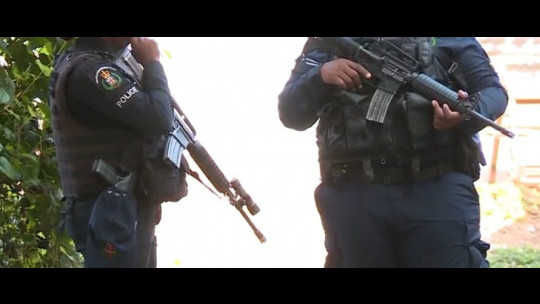
File photo
.png)
Development economist Dr. Chris Stokes and Communication strategist and commentator Damion Mitchell
Development economist Dr. Chris Stokes says the police strategy to kill criminals under questionable circumstances should not be viewed as a strategy to fight crime.
His comment follows an Independent Commission of Investigations (INDECOM) report, tabled in the House of Representatives last Tuesday, which called for law enforcement to take immediate steps to rein in the use of lethal force.
Some 235 people have been killed by the police.
INDECOM said there was no apparent justification for the spike in deadly police shootings.
Dr. Stokes says the number of police killings could set a bad precedent.
"The question is what kind of country are we seeking to established because, as we have seen in the same historical context, somebody now firing back to kill a criminal to make a place safer now realise, oh, I can just fire back and kill somebody and nothing going come out of it, or I don't like this person, or oh my goodness, it's the wrong person but, cho, you're going to have collateral damage. And I think in a civilised country, the questions...asked are questions we should be asking ourselves and that needs to be addressed.
"It cannot be that our strategy as Jamaicans, as the descendants of slaves by the large parts who were wantonly killed, it cannot be that our solution to crime is to kill the criminal and not count that number, don't count how many you kill, but just count how many are being killed and call that progress. I think that is disingenuous and does not serve the country well," Dr. Stokes argued.
Communication strategist and commentator Damion Mitchell believes the issue of police confrontations with criminals has not been handled professionally or "with due respect for people's intelligence".
"I think that, to a great extent, is hammering at the trust in the police and it is making the job that more difficult. The police ought to be commended for the work that they have been doing which have yielded reduction in murders in particular, but let's face it, you can achieve so much more if you take the correct approach," Mr. Mitchell reasoned.
He also expressed concern about what he calls the combative approach taken to concerns by civil society groups to the issue of body-worn cameras.
"And I maintain that this very combative approach by the police in dealing with some of these things, calling out names like Jamaicans for Justice and civil society groups - I mean they're naming and they're saying that they're not going to be determining what formations are going to be getting what cameras. I'm heartened by the fact that the police commissioner has made it very clear that, yes, planned operations will see body-worn cameras being deployed from the thousands which are coming, but that's just a part of the solution to the problem. I mean what your uttering has to be considered to be very critical in this whole analysis," he contended.
comments powered by Disqus





 All feeds


