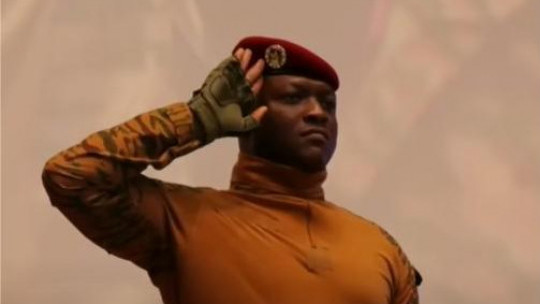
Ibrahim Traore

11:40 am, Tue June 24, 2025
Ibrahim Traore
By Bumpy Walker
“Nuclear fission energy will be commercial in thirty years” is the oft repeated truism on the promise of low cost, carbon free, endless energy. This has been the statement taught to every student of nuclear physics for the last eighty years. This brings to mind a conversation with my father on the 20th of September 1980 while seated under a mango tree shelling pimento. His prophesy: “In twenty-five years everyone will want to go to Africa!”. The reason for this remark, was I had just told him Arnaldo Tamayo, the African Cuban was in space. The local political context was Jamaica’s unacknowledged civil war as the middle class, by fair means or foul, mass migrated to Yankeeland and Canada.
What precipitated this memory, are the recent reports, both on social and traditional media, on the national leader, Ibrahim Traore, of the Burkina Faso. Once more Africa has a leader that excites, unites, disparate groups at home and abroad. It feels like the 70s again, when the young intense upright people, usually with locks or Afros (which would now exclude them from Jamaican school) danced to the Revolutionaires’ dubs, celebrating the avatars of the liberation movements. Songs are being composed in the manner that Lumumba was celebrated musically by Rico, MPLA was dubbed by Sly & Robbie, and Mystic Revelation of Rastafari highlighted Mozambique’s armed struggle.
Ibrahim Traore is the latest in charismatic, handsome, well attired, African leaders with clear masculinity, and articulating an idealistic African vision. While loathing to admit any man is good looking, he is as visually pleasing to watch as Michael Holding off the long run up! His revolution or coup was one of three (Mali, Niger, Burkina Faso) that occurred in West Central francophone Africa in the recent past. All three were extremely popular as the old regimes were ineffective in dealing with the existential challenges that plague their countries as well as the rest of the continent.
As Traore earnestly opens a new tomato paste factory, builds more roads, kicks out former colonialist troops, changes school uniforms to local patterns, celebrities now seek to share in his moral uprightness by declaring fealty to his actions! It may be ironic, as many of Traore’s cheerleaders are the descendants of the middle-class migrants who left Jamaica, spooked by another handsome, charismatic, well attired leader with an idealistic vision.
View with Caution
It is not my intention to re-validate the causes of poor governance or rationalise its lack of economic performance in Africa. These are well known. Rather it is to present a sliver of caution to the justifiable enthusiasm that Traore emotes. The social and economic conditions in Burkina Faso are near analogous to what Haiti faced at its self-liberation more than two centuries ago. Haiti too had a competent leader, Toussiant L’Ouverture. Both the internal and external opposition conspired for that pan Caribbean hero to literally end up coughing to death in a damp prison in the Jura mountains, begging mercy for his family. His central failure was not to have had sustainable social and political institutions.
It cannot be overstated that the legacy of past military coups in Africa has been corruption, incompetence, intolerance of criticism, one party states. Often, initially the putschists dressed their action with life affirming platitudes which everybody can agree with. It is hard to remember now, but General Mobutu did dress his kleptocracy with a veneer of populism. (At one point he did ban women straightening their hair and briefly changed the uniforms of the civil servants to an Afrocentric design). He invented sports washing, using George Foreman and Mohammed Ali’s pugilistic confrontation to try to appeal to the same type of black nationalist thought now embracing the upright man Ibrahim. (Rwanda on Arsenal shirts is a recent sport washing version).
Other leaders too were once the latest military Moses sweeping away the moribund political legacy of colonialism: Flight Lieutenant Gerry Rawlings in Ghana, Staff Sargeant Samuel Doe in Liberia, General Idi Amin in Uganda, General Museveni in Uganda. Nor can Robert Mugabe in Zimbabwe, Abley Ali in Ethiopia, Isaias Afwerki in Eritrea, General Obasanjo in Nigeria be forgotten for their messianic roles. History will judge their experiments, but one hopes that Ibrahim Traore will create a better legacy, given there are now significant case histories to review.
While charismatic leaders build hope, their symbolic gestures can fail, morphing into debt to be serviced, runaway inflation, decades of high interest rates. Cults of personality are easily developed, while destroying institutions needed to build self-sustaining polities. Then, constitutions are suspended, press freedom curtailed, loyal critics become enemies of the state. All power flows through one person. Occasionally, as were the cases of Rawlings and Obasanjo, they recognize their limitations and put civilians back in charge. In most cases it takes decades of delays to build back to the stage that their countries were before their forced entry to leadership at gunpoint.
Green Shoots
Endemic and epidemic poverty remain the single dominant narrative that the world sees in Africa. It is not like Africa is a simple basket case; in the last decade it has had some of the fastest growing economies. Innovations in mobile money systems began its conquest of the planet out of Africa.
As for nuclear fission; in the last few years, a number of experimental reactors have been built by private companies. Even future contracts for fission-generated electricity have been sold. A few weeks back a French company reported it had achieved self-sustainability for more than twenty minutes. Last year researchers at PSFC and Commonwealth Fusion Systems (CFS) achieved ten times the energy output as compared to input, albeit for a few seconds on a fission reactor. Commercial electricity generated by fission is now less than ten years in the future!
In Africa, last week I bought a smart phone sporting the “Made in Egypt” logo. It functions as it is supposed to, is aesthetically pleasing and more competitively priced than the international legacy brands. A sign perhaps that an African renaissance is now, like fission power, less than a decade in the future.
Bumpy Walker is a Afrophile who has worked in and been taxed by more than 10 African nations. (He probably made this lifestyle choice because of that conversation with his father!)

By Bumpy Walker A lon

By Bumpy Walker In th

By Bumpy Walker In 20

By Bumpy Walker Befor





 All feeds