
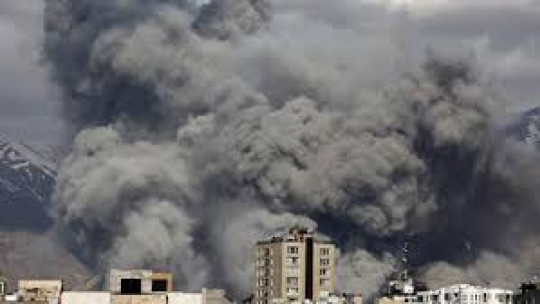
Missiles have been dotting the night skies of Gulf cities across the Middle East.
.png)
Professor Basil Wilson, retired provost at John Jay College of Criminal Justice in New York City and Attorney-at-law Dr. Sanjay Badri-Maharaj
As Jamaica scrambles to rebuild less than five months since Hurricane Melissa, more fallout could be on the horizon for the island due to the US-Iran conflict affecting the Persian Gulf.
Experts say tourism, oil imports, as well as foreign exchange could be negatively affected in the face of the ongoing conflict in the Middle East.
Retired provost at John Jay College of Criminal Justice in New York, Professor Basil Wilson, says the war is expected to create instability for the world economy.
"It's going to lead to a rise in oil prices, which will have an impact in terms of Jamaica's importation of oil.
There's a question that it will have an impact on the stock market in the United States, on the bond market. We don't know how the war is going to be financed, especially if the war is long-term. The United States is $37 trillion in debt. That means the war will have to be financed by further debt. So that is going to be quite inflationary. And any kind of inflation that takes place in the United States will have an impact on the Jamaica economy and on the world economy. In terms of tourism and the movement of people, war tends to have an impact on people being reluctant to really venturing out of their place of abode," reasoned Professor Wilson.
Missiles have been dotting the night skies of Gulf cities across the region.
Several Jamaicans live and work in the United Arab Emirates and the Persian Gulf.
Radio Jamaica has made contact with a group of Jamaicans employed to Maaden Aluminum Company in Saudi Arabia, who say they have been moving between Gulf cities, seeking a safe haven amid growing fear for their lives.
Bahrain and Qatar in the Gulf, as well as Jordan and Kuwait - all home to US military bases - have been actively intercepting strikes coming from Iran. With Saudi Arabia neighbouring Iran, Jamaicans say air assaults have been echoing overhead, borders have tightened and safe routes are disappearing by the hour.
It's why Professor Wilson said Jamaica must consider collaborating with Europe to establish safe spaces for its nationals.
"There's a lot of multinational people who work in these countries. I know that the British has in fact made some attempts to get home a number of their citizens. I think we can link up with many of those NATO countries or European countries as to how to get nationals out of the area, as a lot of those airports have been closed or have been disrupted," he pointed out.
Oil and gas prices have surged as Iran continues to launch airstrikes across the Middle East in response to ongoing attacks by the US and Israel.
Natural gas prices spiked by nearly 50 per cent on Monday after QatarEnergy, one of the world's biggest exporters, halted production following military attacks on its facilities.
Brent crude, the global benchmark for oil prices, jumped by 10 per cent to touch more than $82 a barrel after at least three ships were attacked near the Strait of Hormuz at the weekend.
Iran warned vessels not to pass through the crucial waterway in the south of the country, through which about 20 per cent of the world's oil and gas is shipped.
Attorney-at-law Dr. Sanjay Badri-Maharaj has also warned Jamaicans that should brace for an increase in the cost of goods due to the spike in global oil prices.
However, he said oil prices will soon return to normal because there is no shortage of the product.
Dr. Badri-Maharaj gave a breakdown of the implications of the turmoil in the Middle East, while speaking Monday on the Morning Agenda on Power 106.
"The second thing is you will see a spike in natural gas prices. That is going to take a little while to come down, but it will. For a period of time, international global markets are going to be affected, foreign currencies are going to be affected. The bigger problem is this, what if this lasts beyond four weeks or beyond a month? Then things get very dicey.
"If you have an increase in oil prices that is sustained... you're going to see an increase in inflation, which is going to put pressure everywhere. And remember, the region is a net importer of refined fuel products. One major refinery in the region, Trinidad's Berlin government closed it down, I think. So unless that restarts soon, and it's going to take at least 12 months to restart that, there's no refinery doing anything in this area. So which means we're entirely dependent on importing refined petroleum products," he cautioned.
International shipping has almost come to a standstill at the entrance to the Strait of Hormuz, with analysts warning that a prolonged conflict could push energy prices even higher.
The UK Maritime Trade Operations Centre said two vessels had been struck, and an unknown projectile was reported to have exploded in very close proximity to a third.
comments powered by Disqus





 All feeds


