
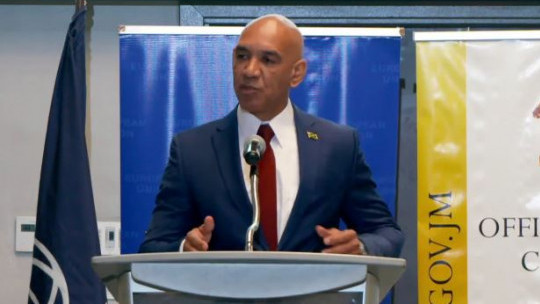
Ambassador Antony Anderson, CEO of the National Reconstruction and Resilience Authority (NaRRA)
.png)
By Nakinskie Robinson
Major General Antony Anderson, Chief Executive Officer of the National Reconstruction and Resilience Authority (NaRRA), is to earn between $35 and $45 million per year in base salary.
He has now been on the job for just over four months as head of the agency tasked with leading the recovery and rebuilding efforts after Hurricane Melissa.
"In the law, he's the Chief Executive Officer, but I am going to call him the Chief Executing Officer, the man who will get things done," Prime Minister Dr. Andrew Holness said of Ambassador Anderson.
The man chosen to lead NaRRA is no stranger to public service, having served as former Commissioner of Police and former Chief of Defence Staff of the Jamaica Defence Force.
But the new job comes with a significant price tag.
Freshly obtained documents via an Access to Information request by Radio Jamaica News back in July, put the CEO's base salary at $35 to $45 million per annum.
Comparatively, this is above the going rate for CEO of the National Works Agency, which is in charge of Jamaica's main road network and flood control system.
An advertisement for the post of CEO at the NWA in the Sunday Gleaner on June 7, 2026 shows a starting salary of just over $17 million.
The minimum requirements include a post-graduate degree in civil engineering, construction management or a highly related field, 10 years experience, at least seven years at the senior level and a demonstrable record in directing large-scale infrastructure projects.
NaRRA's minimum requirements include a master's degree in engineering, public policy, economics, construction management, disaster risk management, business administration or a related field, and 12 to 15 years of senior leadership experience in large-scale infrastructure, reconstruction, disaster recovery, public investment or development programmes.
The requirements also include proven engagement with multilateral development banks and donors.
As for additional emolluments for the NaRRA head, Ambassador Anderson is set to benefit from a performance incentive of up to 25 per cent of his base salary.
But the documents obtained do not make clear what criteria would trigger that incentive.
Other allowances include a fully maintained vehicle and, of course, security.
His contract term will run three to five years with the possibility of renewal.
According to the Office of the Prime Minister, NaRRA is funded through a combination of international multilateral development financing, parametric insurance payouts, capital markets transactions and the national budget.
This is where the numbers matter even more.
NaRRA is being positioned as the central player in Jamaica's post disaster recovery at a time when several families are still trying to rebuild and the public is demanding updates on how the reconstruction money is being spent.
But in the last five days, NaRRA has found itself at the centre of public backlash over its planned headquarters at the Digicel Building in downtown Kingston.
The five-year lease was announced at $115 million per annum. But swift outrage then triggered the government to scale back to less space to reduce the cost.
Still, NaRRA has been controversial long before the debate over its office space.
The opposition People's National Party has stridently challenged its establishment and questioned its role, its costs and how it will operate alongside existing disaster management institutions.
With the leadership's compensation package now drawing attention, Radio Jamaica News asked Jeanette Calder, Executive Director of the Jamaica Accountability Meter Portal (JAMP), what should Jamaicans expect in return?
"Paying less can be costly if it produces poor delivery ultimately. But paying more will buy us no assurance of competence or integrity or results, and so we need more information to determine where we are going to land. And what are we rewarding? Would we be rewarding in the bonus things like how much money has been spent out of the budget, how many contracts have been awarded, or how many projects started? Those are poor incentives. Now in the absence of the long publicly requested board, who will make these determinations? Will it be his direct report? Is that the Prime Minister? One individual? These are questions that still need to be answered," she insisted.
According to Ms. Calder, in a country with limited fiscal resources and competing demands, while the compensation could be justifiable, there must be measurable results.
"I think Jamaica can justify paying well for exceptional reconstruction leadership. And this figure that Radio Jamaica is sharing suggests that this is what we are to expect - exceptional leadership. But in a country that is facing what looks like economic contraction, certainly rising living costs, and almost one year later, unmet hurricane recovery needs, when you put that all together, we ought not really to be looking for the ideal compensation package, certainly not maybe for the first year or two," she reasoned.
comments powered by Disqus






 All feeds


