
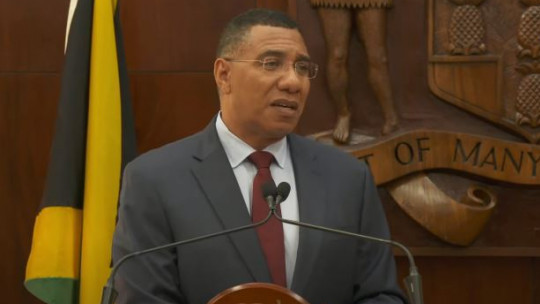
Prime Minister Andrew Holness
.png)
Prime Minister Andrew Holness
By Racquel Porter
Prime Minister Andrew Holness has acknowledged that Jamaica is facing a looming crisis with the continued low pass rate for Caribbean Secondary Education Certificate (CSEC) Mathematics.
For the 2024 sitting, only 38.9 per cent of students who sat the exam received a pass.
Mr. Holness said the result is concerning, arguing that "The country cannot develop without us doing better at mathematics."
He said failure to achieve passes in the subject area is not just a social problem, but improving the outcome is imperative to the development of Jamaica's economy.
"The jobs that are paying better and the jobs that we need to attract to Jamaica, which pays better, involve science, technology, engineering and mathematics."
He argued that while there is constant talk about low wages and the need for higher pay, "wages don't just come out of the sky, you don't just increase wages like that.... You can increase the wages as much as you want. But if it is not tied to something that is in the real sector, then all we're doing is creating inflation".
Mr. Holness acknowledged complaints that Jamaica has been described as a low growth and low wage society. But he maintained that wages are tied to particular industries and their output.
"If we're going to be bringing in new jobs that are going to be paying higher wages, those industries, if we're going to break from the traditional industries of BPOs and hotels, to start to think now about... assembly of microchips; not making them, you know, but just to assemble appliances and electronic equipment that are made here. Let's think about industries in medical technology. These are industries that require this very high level of training, and that is where we will need to be focused," he asserted.
The Prime Minister reasoned that for transformation to take place, the country has to adopt a culture of high skill and high productivity. He said this transformation begins with the Primary Exit Profile (PEP) generation.
"We need to guarantee that 20 to 30 per cent of our students will go into PEP, and we will be able to produce the engineers that we need. The truth is that we simply do not have enough engineers. We do not have enough data analysts and data scientists. We just simply do not, and the focus, therefore, has to be on how do we very rapidly ensure that a smaller number of students that are going into the education system each year, that we have an increasing number of them that are in an almost protected environment, where they can be channelled, supported, and protected into developing the STEM skills that are necessary. And that is a strategy that we will have to employ to rapidly reach this level of productivity," said Mr. Holness, who was speaking on Thursday at the Office of Prime Minister's PEP awards function at Jamaica House.
Meanwhile, the Prime Minister, while agreeing that more funds should be invested in the education ministry, questioned whether the current allocation could be spent differently to get better results.
He conceded that futher transformation of the education sector is needed in terms of curriculum, teacher training, and infrastructure development.
comments powered by Disqus






 All feeds


