
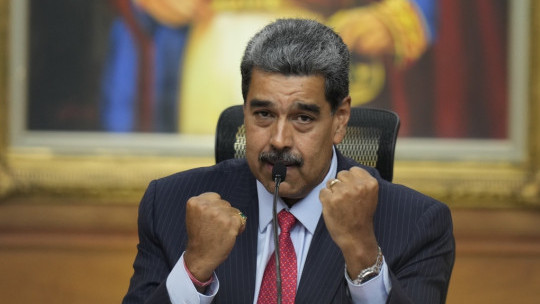
Venezuelan President Nicolás Maduro
.png)
Attorney-at-law and historian Dr. Sanjay Badri-Maharaj
Attorney-at-law and historian Dr. Sanjay Badri-Maharaj is of the view that there may have been collusion between some officials within the Venezuelan government and the Trump administration to remove Nicolás Maduro from power.
The deposed Venezuelan leader and his wife Cilia Flores were captured and brought to the US on Saturday and appeared in federal court in New York City on Monday at noon.
Maduro and Flores are charged in the US with narco-terrorism conspiracy, cocaine importation conspiracy and weapons offences.
Speaking Monday on the Morning Agenda on Power 106, Dr. Badri-Maharaj claimed that the operation could not have been done without connivance of the current government in Venezuela.
He pointed out that the Venezuelan military remained largely untouched during the invasion and was still not able to effectively defend the South American country.
"Why I say there has been connivance is for one very important thing. There was so little resistance from the Venezuelan military. And I contrast this with even unpopular governments like Panama, where the Panama Defense Forces put up a fair amount of resistance, if not particularly effective resistance, they put up quite a bit. Grenada, where you had an extremely unpopular government in Revolutionary Military Council at the time in '83, they put up more resistance. We saw minimal resistance from the Venezuelans except for those in the immediate proximity of Maduro. This suggests that at least some level of order was given to them to stand down," he suggested.
Still, Dr. Badri-Maharaj argued that Maduro's fate was ultimately sealed by his own arrogance.
"Look, [Hugo] Chávez was no paragon of virtue, but Chávez was not an ostentitious flaunter of wealth. He was not a clown. He kept his pulse to the ground as much as was necessary to retain a semblance of legitimacy and therefore keep his office. Maduro was increasingly disconnected from reality and relied heavily on instruments of state repression to remain in office. He did not take things seriously. And as such, when you are so convinced of your own power, you don't see it. You don't see the threats that could emerge around you. A healthy dose of paranoia is always good for a leader, especially one who is in power on dubious grounds," said the attorney and historian.
In the meantime, Dr. Badri-Maharaj has taken aim at CARICOM's response to recent developments in Venezuela, arguing that the bloc failed to demonstrate leadership following the United States' military action and the detention of President Nicolás Maduro and his wife.
CARICOM, in a short statement issued on Saturday, said it was closely following the situation, describing it as a "matter of serious concern with potential consequences for neighbouring states".
But Dr. Badri-Maharaj said the response fell far short of what the moment required.
He argued that statements of this nature do little to influence international affairs and instead reinforce the perception of CARICOM as ineffective on the global stage.
Dr. Badri-Maharaj said the regional body must acknowledge the reality of operating in a hemisphere dominated by the United States that, he contends, routinely ignores democratic norms when engaging with governments in the region.
"Frankly, the CARICOM statement might as well have not come. I mean, it was a meaningless set of drivel and every time CARICOM puts out meaningless drivel, it shows itself to be what it is - an impotent force in geopolitics.
He continued: "I think we need to do some very plain speaking in a very dangerous environment now, and that is CARICOM needs to come to terms with a very, very, very stark reality - that we are dealing with a rogue United States in this region, and this is a country that does not consume itself with the democratic principles of our governments or anything else. What they want is acquiescence to any actions they take no matter how ridiculous."
The United Nations Security Council met in an emergency session in New York on Monday to discuss the recent US action in Venezuela.
The meeting was convened after a request from Colombia that was backed by China and Russia.
Addressing the meeting, Colombia's Permanent Representative to the United Nations in New York Ambassador Leonor Zalabata Torres said the attack on Venezuela represents clear violations of the sovereignty, political independence and the territorial integrity of Venezuela.
She noted this unilateral action will result in an increase in the migrant population of countries in the region such as Colombia.
The UN chief António Guterres told ambassadors, there must be respect for national sovereignty, political independence and territorial integrity, after warning on Saturday that the US had set a dangerous precedent for the world order.
comments powered by Disqus


.jpg)

 All feeds


