
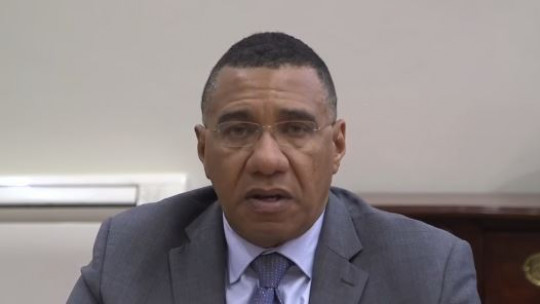
Prime Minister Dr. Andrew Holness
.png)
Prime Minister Dr. Andrew Holness
By Kimone Witter
The government has signed a loan agreement with the Caribbean Development Bank (CDB) to support the Jamaica Rural Water Supply Programme.
The US$36-million project, financed largely by the CDB, is expected to enhance access to potable water for more than 40,000 residents through six water supply schemes spanning five parishes.
The programme will support water-supply improvements in the parishes of St. Mary, Trelawny, St. Elizabeth, St. Thomas and St. Ann.
Prime Minister Dr. Andrew Holness said the financing represents continued progress in the Government's efforts to expand access to reliable, utility-grade or piped water, particularly amid increasing pressure on the nation's water resources.
Speaking at Thursday's signing ceremony at the Jamaican Consulate in Miami, Dr. Holness said it was taking place as Jamaica is experiencing prolonged drought conditions caused by the El Niño weather phenomenon.
"What we're doing here will not solve the climate change issues which drive the El Niño phenomenon. It is not going to immediately solve all of Jamaica's water shortage problems. But what we're doing here is making steady progress in the provision of utility-grade water supply to Jamaica," he asserted.
The Prime Minister indicated that utility-grade water currently reaches between 75 and 80 per cent of the population, with the National Water Commission serving more than two million Jamaicans through over 400,000 customer accounts.
Meanwhile, Dr. Holness has lamented that despite the provision of water, free of cost, to some households and communities through the National Water Commission, persons continue to illegally tap into its systems.
Social water refers to the provision of potable water to persons who are unable to pay the full cost for the service.
The Prime Minister admitted that the government must do more to reduce illegal abstraction.
He said it is imperative that there is a transparent system of social water for households and communities to get legitimate access to water, so that the government can better manage the country's water supply.
"The idea is not to deprive persons of water. The idea is to properly account for all the water that we supply, so that we can make a conscious instrumental decision about who we're going to give water for free and who is charged for water. Right now, as it is, the customer who is paying their water bill is probably paying more than they should because they have to subsidise persons who can pay and don't pay, who should pay and don't pay. And persons who shouldn't pay are getting, but are using much more than they need because they don't have to conserve," he noted.
comments powered by Disqus



 All feeds


